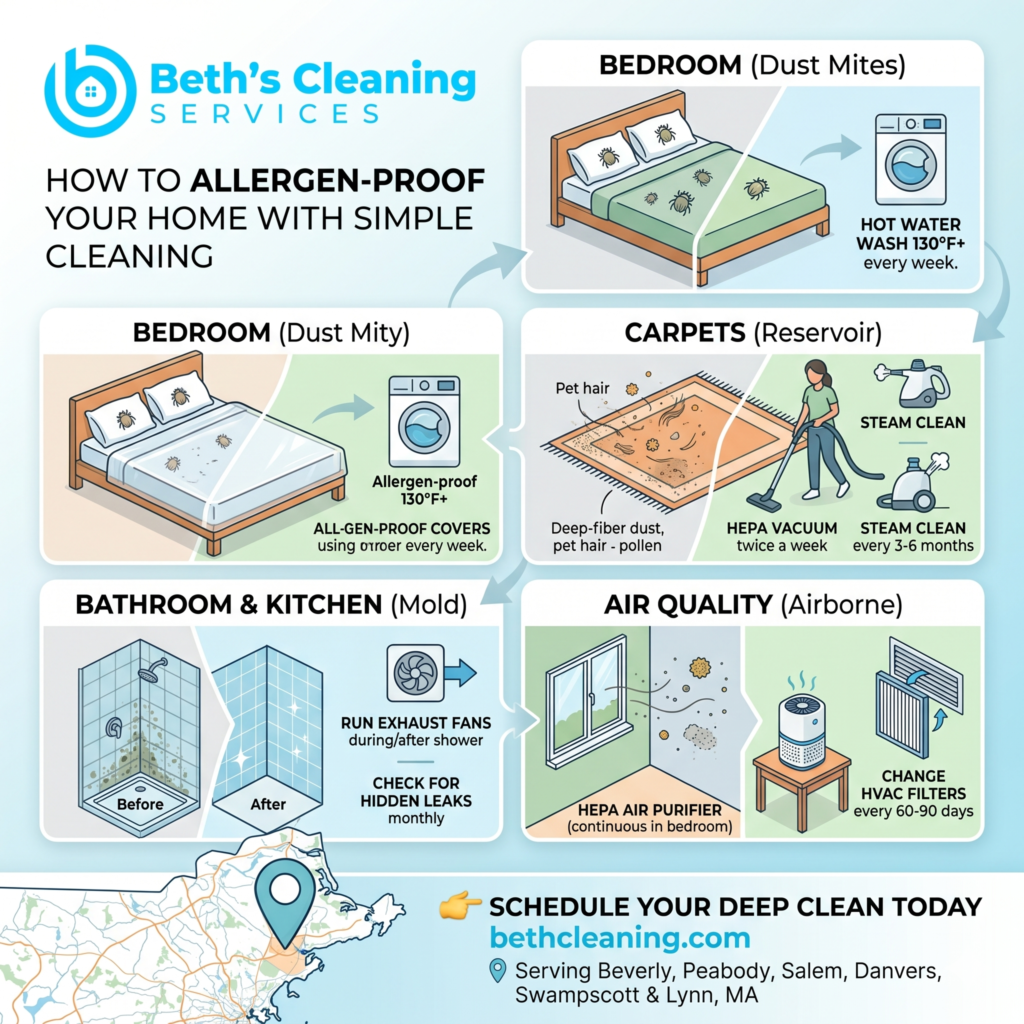
Millions of people suffer from indoor allergies without realizing their own home is the problem. Sneezing, itchy eyes, and congestion that never fully go away are often caused by allergens hiding in plain sight — in carpets, bedding, upholstery, and air vents. The good news: the right cleaning habits eliminate most of them entirely.
The Most Dangerous Allergens in Your Home
Before you can fight allergens, you need to know where they live. The four most common indoor allergens are:
- Dust mites — microscopic creatures that thrive in mattresses, pillows, and upholstered furniture
- Pet dander — tiny skin flakes shed by cats, dogs, and other animals that float through the air and settle on every surface
- Mold spores — produced in damp areas like bathrooms, basements, and under sinks
- Pollen — tracked indoors on clothes, shoes, and through open windows
Each requires a slightly different approach to control effectively.
Your Bedroom Is the Highest-Risk Room
Most people spend seven to nine hours in their bedroom every night. That makes it the room where allergen exposure matters most. Dust mites in particular thrive in warm, humid bedding — and the average mattress contains millions of them.
Three changes that make an immediate difference:
- Wash all bedding in hot water — at least 130°F — every week
- Use allergen-proof covers on mattresses and pillows
- Vacuum the mattress surface monthly with an upholstery attachment
The Asthma and Allergy Foundation of America recommends these steps as the single most impactful intervention for dust mite allergies.
Carpets Hold More Than You Think
Carpets are the largest allergen reservoir in most homes. They trap dust mites, pet dander, pollen, and mold spores deep in their fibers — far below the surface a standard vacuum can reach.
What actually works:
- Vacuum at least twice a week using a HEPA-filter vacuum
- Steam clean carpets every three to six months to kill dust mites at depth
- Consider hard flooring in bedrooms if allergies are severe — it removes the reservoir entirely
Hard floors don’t eliminate allergens, but they make them far easier to remove with regular cleaning.
Bathrooms and Kitchens: Mold’s Favorite Rooms
Mold spores are a powerful allergen and they thrive wherever moisture lingers. Bathrooms and kitchens are the highest-risk areas in any home.
Prevention is straightforward:
- Run exhaust fans during and after every shower
- Fix leaks immediately — even small ones create ideal mold conditions within 24 hours
- Wipe down shower walls and tub surrounds after use to eliminate standing moisture
- Check under sinks monthly for hidden dampness
Visible mold on grout or caulk should be treated with a bleach-based cleaner and scrubbed thoroughly. If mold covers an area larger than ten square feet, professional remediation is the safer option.
Air Quality Is Part of the Equation
Cleaning surfaces removes allergens that have already settled. But allergens in the air require a different approach entirely.
Two investments that deliver outsized results:
- A HEPA air purifier in the bedroom runs continuously and captures airborne particles before they settle
- Changing HVAC filters every 60 to 90 days prevents your heating and cooling system from recirculating allergens throughout the entire home
Together, these two steps address the airborne allergen problem that surface cleaning alone can’t solve.
When Allergens Are Beyond DIY Control
Standard cleaning routines manage allergens but rarely eliminate them completely. Professional deep cleaning reaches the areas that accumulate the heaviest loads — inside upholstery, along baseboards, behind furniture, and in air vents. A thorough professional clean combined with consistent daily habits is the most effective allergen control strategy available.
At Beth’s Cleaning Service, we clean with allergen reduction in mind — systematically, thoroughly, and with professional-grade equipment that goes beyond surface level.
👉 Visit bethcleaning.com to schedule your deep clean today.
📍 Serving Beverly, Peabody, Salem, Danvers, Swampscott & Lynn, MA