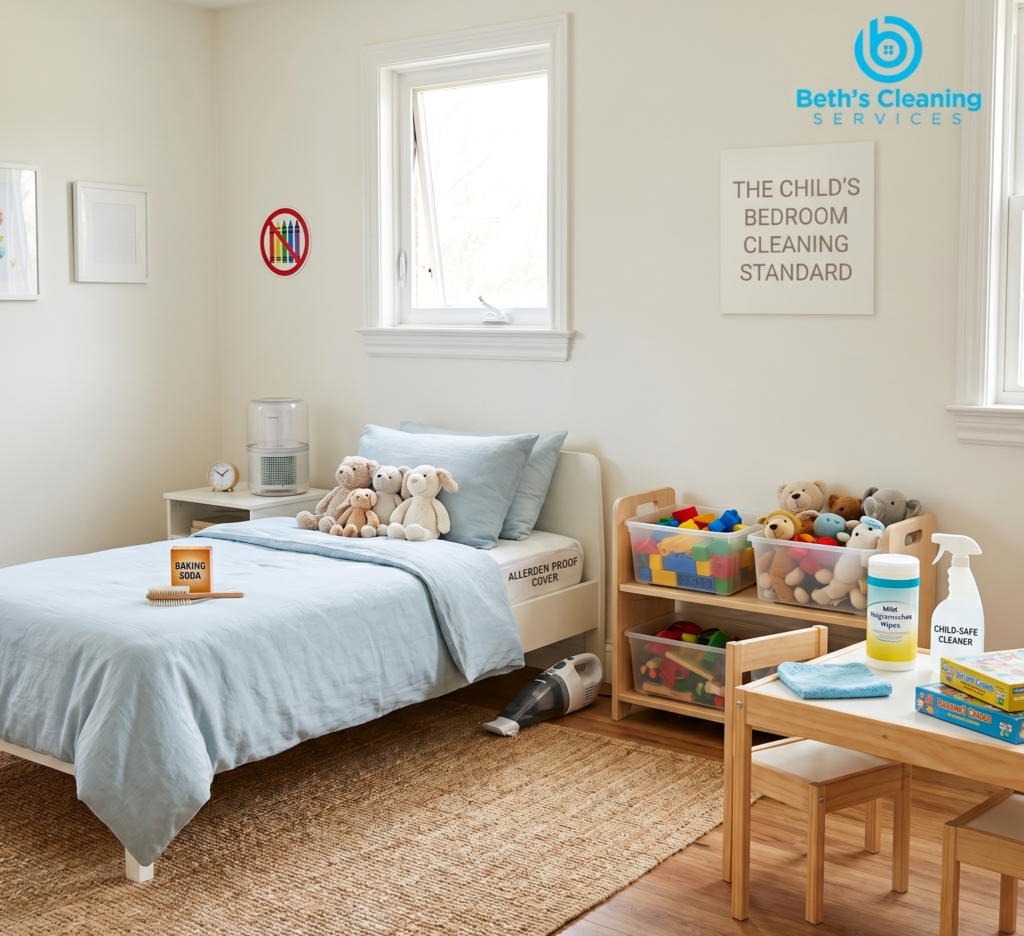
Children spend more time in their bedroom than any other room in the house. They sleep there, play there, eat snacks there, and bring everything they’ve touched throughout the day directly into that space. Yet children’s bedrooms are frequently cleaned to a lower standard than the rest of the home — tidied regularly but deep cleaned rarely. Given how much time children spend in that room and how directly its cleanliness affects their health, it deserves a higher standard, not a lower one.
Why Children’s Bedrooms Accumulate More Than Adults Realize
The combination of factors that makes a child’s bedroom a significant cleaning challenge is unique. Toys touch floors and then mouths. Stuffed animals are slept with nightly and washed infrequently. Snacks get consumed and crumbs scatter into carpet and furniture. Art supplies leave residue on surfaces. And children are simply less aware of — and less concerned by — the cleanliness of their environment than adults.
The result is a room that looks manageable on the surface while accumulating dust mites, bacteria, allergens, and hidden grime at a rate higher than most other rooms in the home.
Toys Are the Biggest Hidden Problem
Toys are handled constantly, shared with other children, taken outside and brought back in, and almost never cleaned with any consistency. They are one of the primary vectors for bacteria and illness transmission in households with young children.
Hard plastic and rubber toys:
Wash weekly in warm soapy water or run dishwasher-safe toys through a full dishwasher cycle. For toys that cannot be submerged, wipe thoroughly with a disinfectant wipe and allow to dry completely before returning to the child.
Soft toys and stuffed animals:
Machine wash monthly on a hot cycle if the toy’s care label permits. For stuffed animals that cannot be washed — antique toys, musical toys with electronics — place them in a sealed plastic bag and freeze for 48 hours. Freezing kills dust mites effectively without damaging the toy. Allow to return to room temperature before returning to the child.
Board games, puzzles, and art supplies:
Wipe down boxes, game boards, and frequently handled pieces with a disinfectant wipe quarterly. Art supply containers accumulate dried residue and bacteria from hands that have been handling paint, glue, and clay — clean them far more regularly than most parents consider.
The Mattress and Bedding Standard for Children
Children’s mattresses accumulate dust mites, moisture from perspiration, and allergens at a rate comparable to adult mattresses — and the consequences of that accumulation are more significant for children, whose immune and respiratory systems are still developing.
The cleaning standard for children’s bedding is higher than for adult bedding:
- Wash all sheets and pillowcases twice weekly — children sweat more during sleep and move more, transferring more body oils and skin cells to bedding
- Wash stuffed animals that share the bed monthly at minimum
- Vacuum and baking soda treat the mattress every two months
- Use allergen-proof covers on both the mattress and pillows — the American Academy of Pediatrics identifies allergen-proof bedding covers as one of the most effective interventions for reducing dust mite exposure in children with respiratory sensitivities
Floors in a Child’s Bedroom
Children spend more time on the floor than adults — playing, reading, doing homework, and simply existing at floor level in a way that adults rarely do. The floor in a child’s bedroom is not just a walking surface — it’s a primary contact zone.
Carpet in a child’s bedroom requires vacuuming at least twice weekly and steam cleaning every two to three months. The frequency reflects the reality of how children use the floor and what accumulates in carpet fibers at that level of contact.
Hard floors in children’s bedrooms should be mopped weekly with a child-safe cleaner — standard floor cleaners contain chemicals that are safe for incidental adult contact but more problematic for children who sit and play directly on treated surfaces.
Walls and Surfaces at Child Height
Children touch walls constantly — for balance, during play, and simply because they do. The wall surfaces at child height in a bedroom accumulate hand prints, food smears, crayon marks, and general grime at a rate far exceeding the same surfaces in adult spaces.
Wipe walls at child height monthly with a damp microfiber cloth. For crayon marks, a small amount of white toothpaste on a damp cloth removes most marks from painted walls without damaging the finish. For persistent marks, a magic eraser used gently is effective — test on an inconspicuous area first as it can dull some paint finishes.
Wipe light switches, door handles, and window sills weekly. These surfaces are touched constantly by hands that have been in contact with toys, food, and outdoor surfaces throughout the day.
Air Quality in a Child’s Bedroom
Children breathe more air relative to their body weight than adults — which means the air quality of the room where they sleep directly affects their health more significantly than the equivalent exposure would affect an adult.
Three changes that improve bedroom air quality for children:
- A HEPA air purifier running continuously captures the airborne allergens, dust, and particles that surface cleaning cannot address
- Opening the window briefly each morning exchanges overnight air and reduces accumulated carbon dioxide and humidity
- Avoiding strong chemical cleaners in the child’s bedroom — use fragrance-free, child-safe products throughout the room and allow it to ventilate after any cleaning before the child returns
The Clutter Connection
A cluttered child’s bedroom is harder to clean thoroughly — surfaces are inaccessible, floors are covered, and cleaning works around the mess rather than through it. Beyond the cleaning challenge, research consistently links bedroom clutter to disrupted sleep quality in children.
A weekly ten-minute toy and clutter reset — done with the child where age appropriate — keeps the room at a level where thorough cleaning is fast and effective. Teaching children to participate in maintaining their space also builds habits that serve them for life.
When Professional Cleaning Makes the Difference
A child’s bedroom that has never been properly deep cleaned carries accumulated allergens, dust mite populations, and embedded buildup in carpets and mattresses that standard cleaning cannot fully address. A professional deep clean resets the room to a baseline that genuinely protects your child’s health — and makes your regular cleaning routine far more effective going forward.
At Beth’s Cleaning Service, we clean children’s bedrooms with the care and attention that the most important people in your home deserve — safe products, thorough execution, and a standard that gives parents genuine peace of mind.
👉 Visit bethcleaning.com to book your deep clean today.
📍 Serving Beverly, Peabody, Salem, Danvers, Swampscott & Lynn, MA