How to Keep a Clean Home During a Renovation Project
Renovations are exciting and absolutely brutal on a home’s cleanliness. Dust travels further than anyone expects. Debris appears in rooms nowhere near the work zone. Foot traffic from contractors tracks material through every corner of the house. Most homeowners accept the chaos as inevitable and plan to deal with it when the project is done. A smarter approach keeps the home livable throughout — and makes the final cleanup dramatically easier.
Dust Travels Further Than You Think
Construction dust is not like household dust. It is finer, heavier in volume, and travels through air currents to rooms far from the work zone. Drywall dust in particular is so fine it passes through standard doorway gaps and settles on surfaces two and three rooms away within hours.
Understanding this changes how you approach containment. Closing a door to the work area is not sufficient. Sealing it is.
Containment Is the First Priority
Before any work begins, invest time in proper containment. Done correctly it reduces cleaning throughout the project by more than half.
What effective containment looks like:
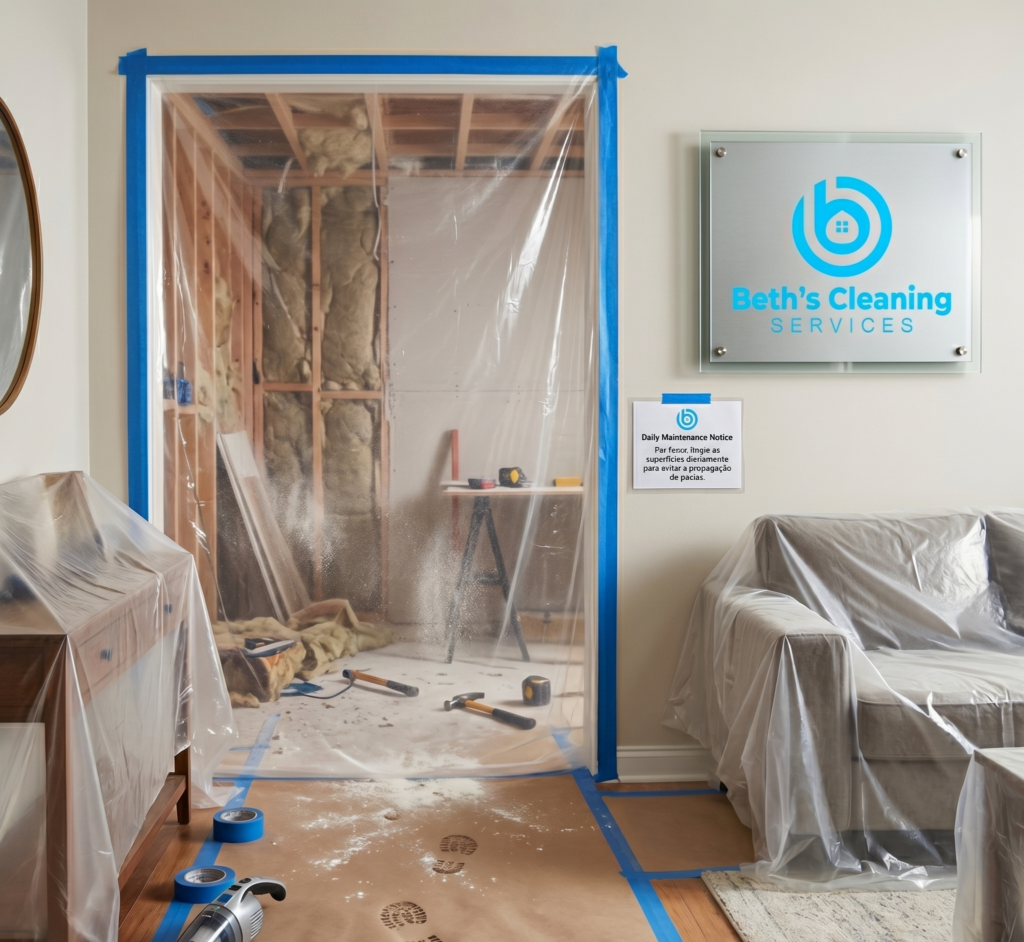
- Seal work zone doorways with plastic sheeting taped completely around the frame — not draped loosely over the opening
- Cover HVAC vents in and near the work zone with plastic and tape to prevent dust from entering the duct system and distributing throughout the entire home
- Lay heavy drop cloths or rosin paper along every contractor path from the entrance to the work area
- Seal gaps at the bottom of doors with draft excluders or rolled towels
Containment is the single highest-return preparation step in any renovation cleanup strategy.
Protect What Matters Before Work Starts
Furniture, flooring, and belongings left unprotected during renovation accumulate dust and damage that is far harder to address after the fact than before.
Before contractors begin:
- Remove furniture from rooms adjacent to the work zone where possible — not just the room being renovated
- Cover everything that cannot be moved with plastic sheeting secured with tape
- Remove rugs from all affected areas — renovation dust embeds into carpet fibers at a depth that standard vacuuming cannot reach
- Store small valuables and decorative objects completely away from the work zone
Protecting surfaces before work begins costs thirty minutes. Restoring damaged or dust-saturated surfaces after costs significantly more.
Daily Habits That Prevent Compounding Mess
Even with strong containment, some dust and debris escapes the work zone daily. Small daily habits prevent that escape from accumulating into an overwhelming cleanup problem.
What to do every evening after contractors leave:
- Vacuum the transition zones — entryways, hallways, and any path contractors walked
- Wipe down door handles, light switches, and surfaces in adjacent rooms with a damp cloth
- Check and replace HVAC filters more frequently than usual — every two to three weeks during active renovation
- Sweep or vacuum the work zone itself if contractors haven’t — debris tracked out the next morning doubles the spread
Five minutes of daily containment management prevents hours of catch-up cleaning at the end of the week.
The Kitchen and Bathrooms Need Extra Protection
These two rooms cannot be taken out of service during most renovations — they need to remain functional throughout. They also need specific protection because renovation dust in food preparation areas and plumbing fixtures creates hygiene problems beyond simple mess.
Kitchen protection during renovation:
- Keep all food in sealed containers or behind closed cabinet doors at all times
- Cover the stovetop and counters with plastic when not in use
- Wipe down all food preparation surfaces before cooking every single day regardless of how clean they appear
Bathroom protection is simpler but equally important. Cover the toilet tank and bowl when not in use and wipe faucet handles and the sink basin daily — renovation dust mixed with moisture creates a paste that stains fixtures quickly.
Managing Contractor Traffic
Contractors are focused on the work — not on the cleanliness of the rest of your home. Setting clear expectations at the start of the project prevents the majority of avoidable mess.
Reasonable expectations to establish upfront:
- Designated entry and exit points only — no shortcuts through clean areas of the home
- Shoe covers or a boot brush at the work zone entry point
- Debris removal from the work zone at the end of each day rather than accumulating throughout the week
- Immediate cleanup of any spills or material drops outside the designated work area
Most contractors will respect these boundaries when they’re communicated clearly at the start. Waiting until problems arise makes the conversation significantly harder.
The Final Cleanup Is a Specialized Job
When the renovation is complete, the visible debris is only part of the cleanup challenge. Fine construction dust has settled into every surface, inside every cabinet near the work zone, along every baseboard, and inside HVAC ducts throughout the home. This level of cleanup requires a systematic, professional approach.
Post-construction cleaning is one of the most specialized cleaning services that exists — and one of the most commonly underestimated. Standard cleaning products and methods are not designed for construction dust volume, adhesive residue, paint overspray, and the depth of particulate contamination that even a modest renovation leaves behind.
At Beth’s Cleaning Service, post-construction cleaning is one of our core specialties. We follow a systematic process that clears construction dust completely, restores all surfaces, and delivers a home that is genuinely move-in ready — not just visually clean on the surface.
👉 Visit bethcleaning.com to book your post-renovation clean today.
📍 Serving Beverly, Peabody, Salem, Danvers, Swampscott & Lynn, MA